What kinds of backpacks are there? Which one do I need?
This is a more complicated question than it might seem, at first. Note that the following categorizations are my own terminology; each manufacturer will have its own unique language.
Types of backpacks
Hybrid school/office daypacks are backpacks with capacities generally between 15 and 32 litres, equipped with laptop sleeves. Their design heritage calls back to the Jansport Superbreak, the Herschel Little America, the Fjällräven Kånken, backpacks originally designed for schoolchildren. Some are even based on designs that in the 1970s were professional outdoor athletes’ backpacks. Nowadays, they are represented by lower-quality models manufactured by High Sierra and SwissGear, and popularized at the higher-end by the various North Face Models, such as the Borealis 29, the Recon 30, and the Surge 31. These backpacks are primarily intended for the school or office but usually come with several features to make them suitable for day hikes: stretch mesh water bottle pockets, hiking-style quick access top zippered pocket, adjustable sternum straps, and so on. This is a very crowded space, but if you don’t want to think about it too hard, just get whichever Osprey 365 series model (e.g. Quasar 26, Comet 30, Nebula 32) suits your tastes.
Basic daypacks are backpacks with a wide range of capacities, basic or sometimes even nonexistent ventilation systems, and lack most of the features of the previous category. Many people prefer backpacks with very small capacities, no waist strap, supple and lightweight fabric, very low overall weight, and so on. In terms of fashion, hybrid backpacks are often fussy and complicated, aesthetically, they are often out of step for a dinner date, a job interview, or vacationing in Ireland where locals are likely to poke fun at you for any possible reason. They can of course be used for technical hikes too, just be aware of their limitations. Examples of recommendations include the MEC Pika Pack 15, the Fjällräven Vardag 17, or even the venerable Jansport Superbreak 26 (which overlaps with the previous category). However, since I am performance-, comfort- and value-oriented, I recommend the Osprey Daylite series (or similar) instead.
Hiking daypacks are smaller backpacks, usually between 15 and 30 litres, that have more substantial back systems than basic daypacks or hybrid daypacks. They may have padded hipbelts, which in combination with stiff plastic framesheets and/or a perimeter metal frame, can effectively transfer heavy loads from the wearer’s shoulders, chest, and upper back, down to the pelvis, which can greatly improve the backpack’s load carriage characteristics. If the frame and hipbelt are working correctly, it can transfer more than half the weight from the upper body to the pelvis, and therefore reduce fatigue and soreness over a long hike in rough country. Note that above 25L, we’re talking about a pretty ‘big’ day, perhaps including winter or climbing gear for challenging terrain, or a camera cube for nature photography.
Overnight packs are medium-sized backpacking packs/trekking backpacks that are between 28 and 45 litres, and virtually all of these will now have proper hipbelts except for the most minimalist ultralight designs. Nearly all of them will have a two-buckle alpine-style top lid closure with a cinch cord, instead of the usual two-zipper clamshell-opening to the main compartment. If there is a zippered access to the packbag, it is usually a secondary feature and not the primary method of access. The reason for this is that alpine top lid designs are inherently lighter, more durable, and more weather resistant than most zippered designs. “Overnight” refers to this range being the smallest feasible capacity to hold a Big Four system for a single night in the summer, or a generous amount of gear for mountain hut-to-hut treks. For most people who aren't ultralight aficionados, this capacity range is a tight squeeze for backcountry adventures longer than two consecutive days.
Multiday backpacking packs/trekking backpacks have capacities between 50 and 70 litres and are suitable for up to a week in the backcountry before resupply. Other than being larger, and perhaps having a few more features and pockets, they are largely similar to the previous category.
Winter/expedition backpacks have capacities beyond 70L and are best suited for backcountry trips that have exceptional needs, including backpacking with young children who cannot carry their own backpacks, very long treks beyond seven days between next resupply, carrying a full professional wildlife photographer’s kit in addition to the Big Four, summiting mountains with climbing gear, and/or working as a professional mountain guide. They may be very similar to the previous category, but in some models they will have additional mountaineering-specific features, and frames designed to manage heavier loads (in general, loads greater than 16 kg or 35 lbs.). These backpacks do not have trampoline back systems, as mountaineering requires maximum stability, and the heavier loads would cause the curved frame to bend in uncomfortable ways.
Travel backpacks are designed as airplane luggage, or are otherwise luggage intended primarily for urban environments. Virtually all of them will have a full clamshell zipper, making it open like a suitcase or a duffle bag. Some models may be useful for certain backcountry applications. For example, the Osprey Farpoint/Fairview series are usable for hut-to-hut treks, or even true backcountry trekking in a pinch. This type will be covered in-depth in future articles.
Other kinds of backpacks. Packs outside the scope of this guide include alpine climbing packs, ski packs, mountain biking packs, trail running vests, drybags with backpack straps, hunting packs, and military packs.
Harness systems
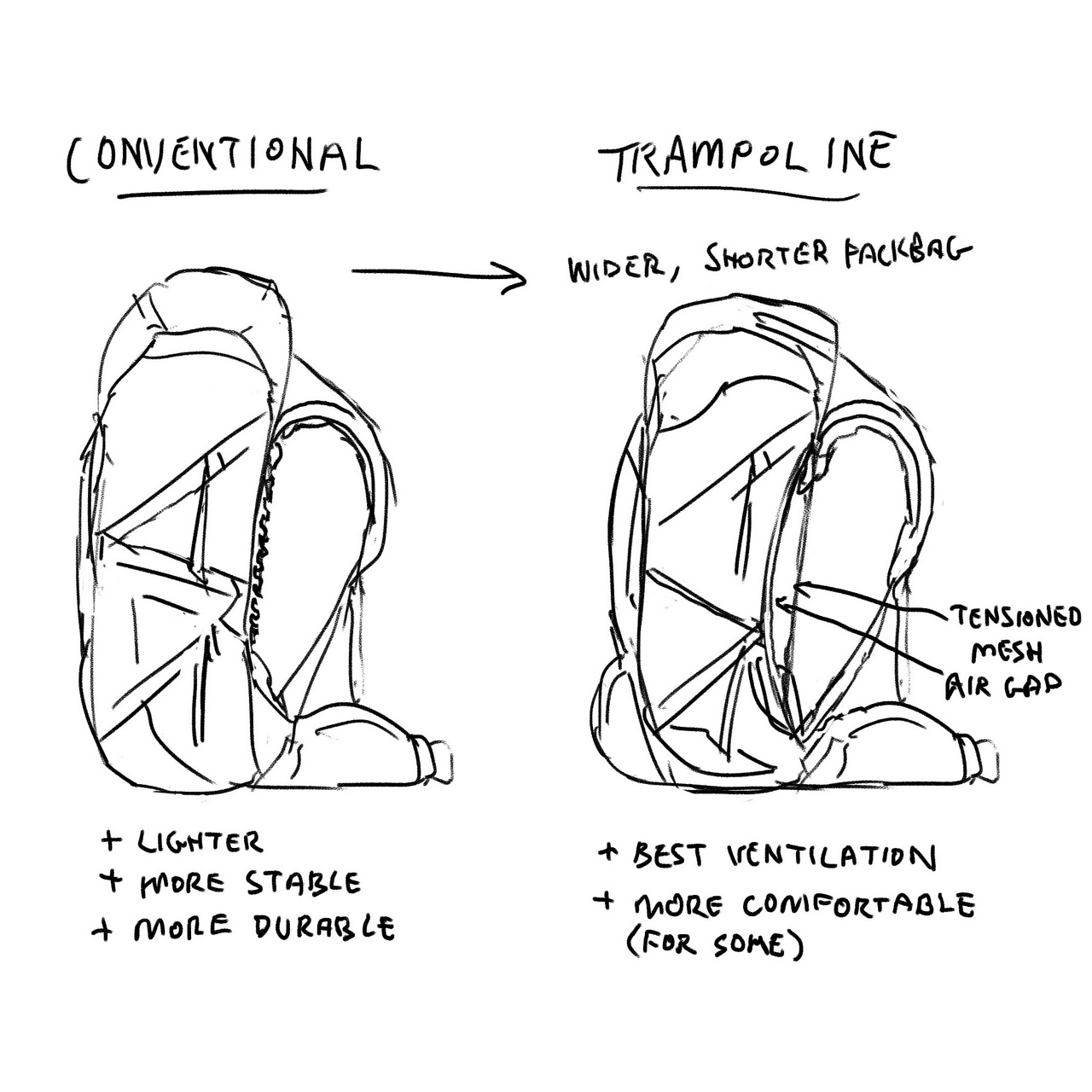
Backpacks can also be categorized by their harness systems (i.e. the design of the shoulder straps, hipbelts, and the back panel):
Conventional harness systems are based on ventilation that rely on a combination of materials to improve comfort and wick away sweat, while maintaining what Deuter calls “full contact” with the entire back. Inexpensive versions of this use spacer air mesh on body contact surfaces (i.e. the back panel and shoulder pads), while more sophisticated versions will use off-the-shell 3D air mesh, novel forms of 3-dimensional structured air mesh (e.g. newer Gregory, Evergoods), or ridged foam overlaid with a thin mesh layer. These systems have the advantages of lower weight, lower manufacturing cost, higher inherent durability, and higher load carriage stability than the alternative. They may include an internal metal stay, a Y-shaped stay, or a perimeter spring steel frame to further enhance load carrying comfort.
Traditional harness systems consist of a lumbar pad and two scapula pads, composed of durable foam and usually covered in a layer of mesh. This creates an area of ventilation along the spine and next to the lower back. These styles were more common in the 1990s and the 2000s, and offered a great compromise between high load stability and high ventilation. It's quite rare nowadays, but the Fjällräven Abisko series, the Sierra Designs Flex Capacitor series, and the recently discontinued Arc'teryx Bora 65 have this type of harness system.
Trampoline harness systems are based on a perimeter spring steel frame that is curved inwards towards the packbag, which creates a concave air gap between the wearer’s back and the rest of the backpack structure. A mesh sheet is suspended between the backpack and the wearer, and it is only this soft mesh layer that is touching the wearer’s back. Invented by the Germans, this history is partially obscured in Deuter’s corporate history webpage, leaving an awkward gap between the early 1930s and the late 1940s. Anyway, this design has two enormous advantages for many wearers, greatly improving both comfort (because the soft mesh feels a lot like the old-fashioned, plush padding that is now extremely rare in modern pack design) and ventilation (thanks to the air gap, allowing perspiration to dry quickly from the wearer's back). The Osprey Atmos AG and Aura AG series of backpacks, famed for its perfection of the trampoline design, became extremely popular choices on the Appalachian Trail, and the Deuter Futura series continues to be a top pick in Europe. Downsides include high weight, slightly higher cost, high complexity, and reduced stability, especially for physically very small people whose centre-of-gravity would be greatly shifted from their natural standing/walking position.