The big four: Description
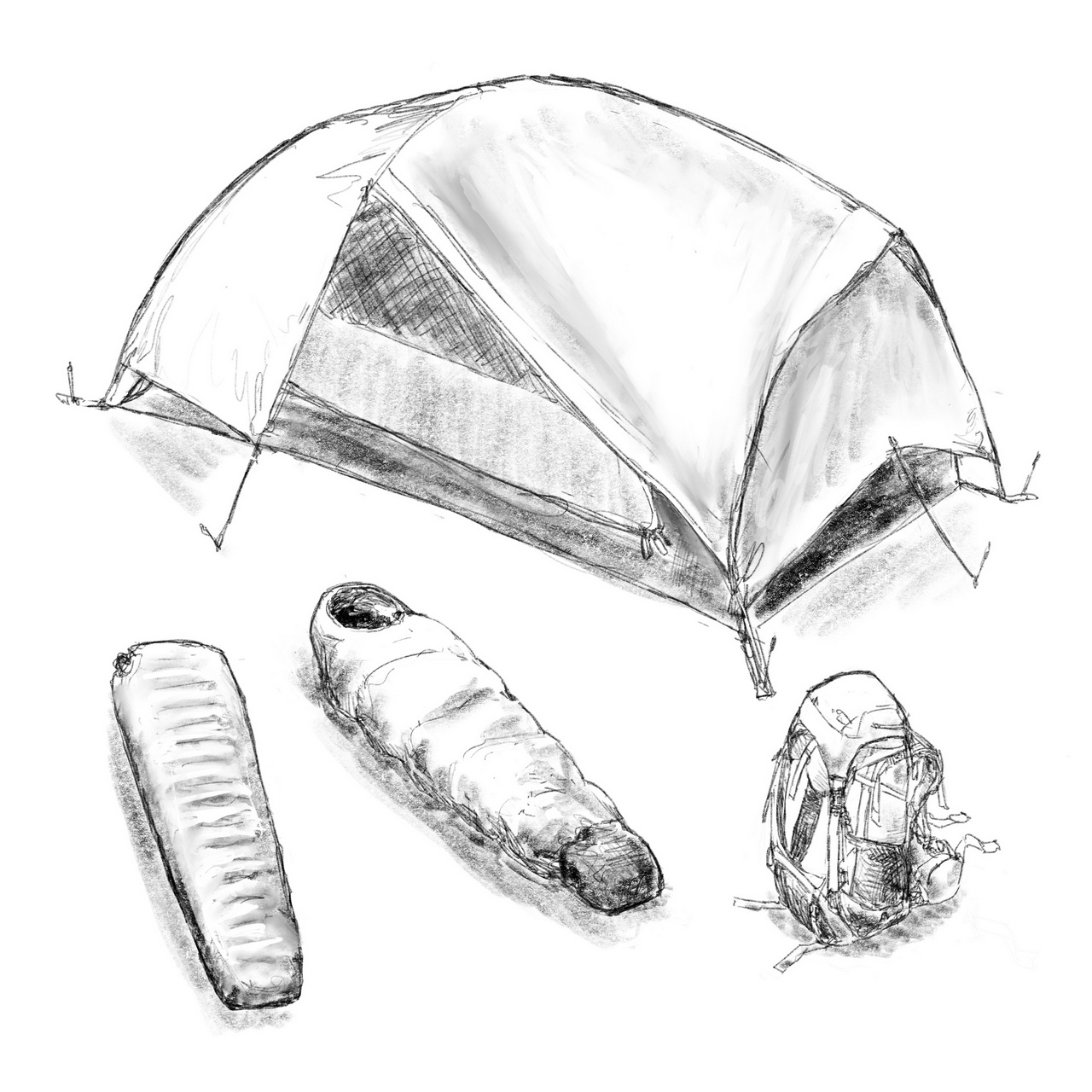
If you’re building out your kit from square one, start here. Your backcountry hiking kit should include the following core components:
- Shelter: Someplace to sleep in, e.g., a tent, tarp and bivy, or hammock. Most tents nowadays are double-walled tents, which means they are composed of an inner tent with mesh walls for ventilation, and an outer tent fly to block wind and rain from entering the mesh. This design is easy in setup, versatile in the kinds of terrain and weather it can handle, and helps move condensation away from your body and your sleeping bag. In places such as the eastern forests of North America, hammocks can be very pleasant to sleep in during summer. During winter and in high alpine environments, a bivy or a single-walled tent may be the best option.
- Sleeping bag: Something to keep you warm while you sleep, rated between 2C to -10C for 3-season conditions (i.e. in temperate climates, late spring, summer, and early fall), or lower than -15C for 4-season (i.e. winter or high alpine) conditions. The insulation is composed of either of down fill, which is lighter and packs smaller for its temperature rating, or synthetic fill, which is bulkier and heavier but can maintain some insulating properties if it gets wet.
- Sleeping pad: Something to sleep on top of, with an R-value between 2.7-4.5 for 3-season, or equal to or higher than 5.0 for 4-season. If you don't use a sleeping pad, the insulation will be less effective, as the insulating material beneath your body will be compressed by your body's weight. This will cause the heat of your body to be conducted into the ground. Some people swear by 'egg crate' closed-cell foam pads because they are inexpensive, indestructible, foolproof, and multipurpose. Air-inflatable pads types are usually preferred nowadays because they are warmer and vastly more comfortable.
- Backpacking pack/trekking backpack: Something to carry all your stuff, with a capacity rating of 50-70L for 3-season, or 75-95L for 4-season. There used to be various different internal frame and external frame backpacks to choose from, but nowadays there's only a single model still in mass production. It may be a good option for people carrying awkward, bulky older gear. Otherwise, internal frame backpacks are lighter and more comfortable, and you can buy them more easily. The frame is usually a perimeter spring steel frame that transfers the majority of the weight of the pack and its contents to your hipbones via a padded hipbelt. It should be fitted properly to your body, and given the same level of consideration as your hitting your hiking boots.