How should I pack my backpack for the backcountry?
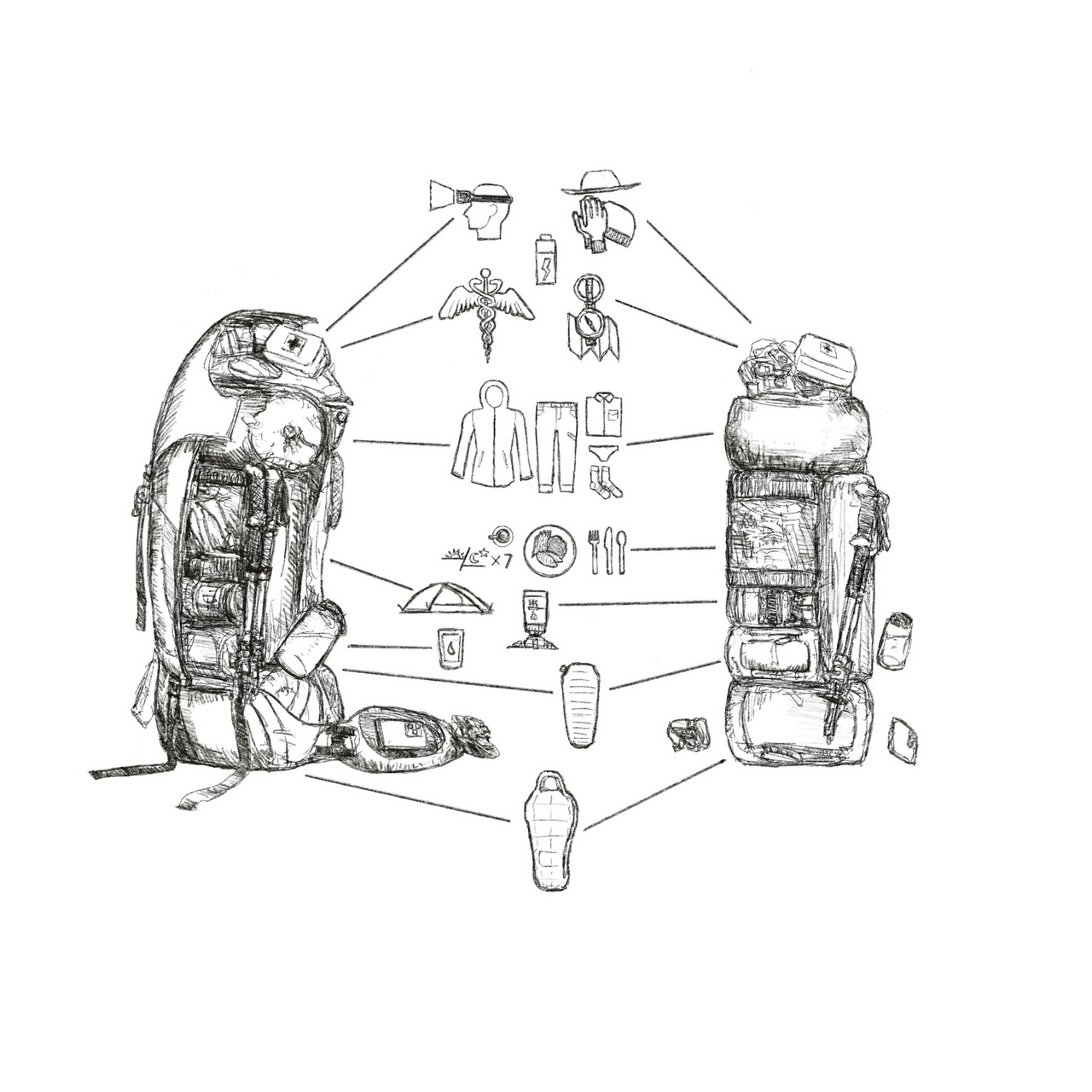 Many alpine-style backpacks only have an alpine top lid opening, and no main zippered opening. There are many reasons for this design feature:
- A zipper blowout in the mountains could be disastrous.
- Top loading designs are inherently more weather-resistant and durable than a zippered opening.
- Every day should have the same order of operations:
- When you arrive at your campsite, begin setting up camp. Pull out your clothing sack, food bag, stove, and fuel, and set them aside.
- Set up your tent.
- Inflate your sleeping pad and lay it down.
- Pull your sleeping bag out of its compression sack and lay it down.
- Cook and eat your dinner.
- Finish cleanup duties and retire for the evening.
The next morning is something like this in the reverse order:
- Cook your breakfast and brew your coffee.
- Break camp. Pack your sleeping bag and put it into the bottom of your pack.
- Deflate your sleeping pad and pack it above the sleeping bag (or if it’s a closed-cell foam pad, strap it to the bottom of your pack).
- Collapse your tent and stow it in your pack.
- Clean and store your stove, cookware, and utensils and place it next to your tent along with your fuel and food bag.
- Place the clothing bag on top, close your pack, and re-engage all your compression straps. Start hitting the trail.
The sleeping bag should always be stored at the bottom for this reason. Therefore, a panel zipper is usually not needed. Since everything comes in and out of the backpack in the same order every day, there shouldn’t be much rummaging around. Modern designs have convenient pockets (usually, at least two hipbelt pockets) for quick-access items to prevent the need for digging around. Since reaching the bottom of the packbag can be cumbersome, most modern designs include a large, zippered bottom opening for convenient access to the sleeping bag.
The main use of the panel or side zipper is to get at smaller items that have shifted and sunk into the middle of the packbag throughout the hike. Alternatively, you may pack something intentionally in the centre of your pack, but wish to pull it out in the middle of the hike (e.g. a camera cube).
A large, zippered panel opening can also be convenient for non-backcountry use, if there is no ‘big four’ because you’re hiking hut-to-hut, or as a substitute for a travel backpack in urban environments. For hut-to-hut treks, I would usually recommend single, large packing cube with a grab handle, which you can pull out easily when you arrive at your accommodations.
Otherwise, packing your bag as suggested above ensures that your weight distribution is optimized. Heavier, denser items should be stored closer to your centre-of-gravity, and the lighter, bulkier items stores further from your centre-of gravity (see the illustration at the top). The lightest thing of all would be a closed-cell foam sleeping pad, which should always be strapped externally with the bottom sleeping pad straps. Some exceptions should be made for important items that may need to be accessed quickly, such your water bottle(s), first aid kit, or bear spray.